
If you’ve ever heard another parent say “my child studies in the state board” and quietly wondered what that actually means, you’re in good company. The state board meaning is straightforward. It is the education board set up by a state government to run school education within that state, from deciding the syllabus to conducting the Class 10 and Class 12 board exams. This guide explains how a state board of education works, how West Bengal’s boards fit in, and how they compare with CBSE and ICSE, so you can pick a board without second-guessing yourself.
Not sure which board is right for your child? Chat with our academic team on WhatsApp for a quick, no-pressure conversation.
What Is a State Board?
A state board is an education board created and managed by a state government. It designs the syllabus, approves textbooks, affiliates schools, conducts public examinations and issues certificates to students studying in that state.
So if you’re searching for what is state board in plain words, think of it as a state’s own school examination authority. A student in West Bengal studies under the West Bengal board, a student in Maharashtra under the Maharashtra board, and so on.
State Board of Education in India and How It Works
Education in India sits on the Concurrent List of the Constitution, which means both the central government and the states can make decisions about it. You can read more about this setup in the Wikipedia overview of education in India. Because of this, almost every state and several union territories run their own boards, so the total number is well over thirty.
A typical state board of education takes care of the following:
- Framing the curriculum and syllabus for school classes
- Choosing or publishing textbooks
- Recognising and affiliating schools
- Conducting the secondary (Class 10) and higher secondary (Class 12) examinations
- Declaring results and issuing marksheets and certificates
Many state boards also take guidance from national frameworks and from NCERT, while keeping their own textbooks and regional focus. The exact names change from state to state. Class 10 might be called Madhyamik, SSC or SSLC depending on where you live.
The West Bengal State Boards
For families in West Bengal, two bodies matter most:
- West Bengal Board of Secondary Education (WBBSE) looks after secondary education and conducts the Madhyamik examination at the end of Class 10.
- West Bengal Council of Higher Secondary Education (WBCHSE) manages Classes 11 and 12 and conducts the Higher Secondary examination.
Both follow a syllabus prepared for the state, and schools can teach in languages such as Bengali and English. Educom supports English medium students of the West Bengal State Board with online tuition, along with CBSE and ICSE students.
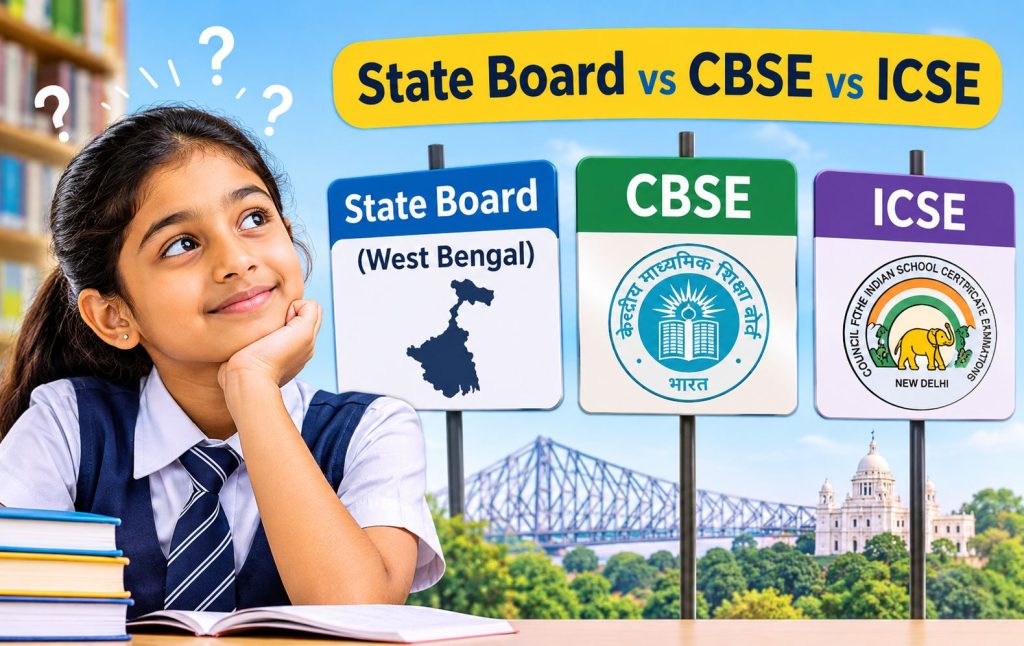
State Board vs CBSE vs ICSE
This is the question behind most searches for state board meaning. Parents don’t just want a definition, they want to know how it compares.
| Feature | State Board (West Bengal) | CBSE | ICSE |
| Run by | State government bodies (WBBSE and WBCHSE) | Central government board | CISCE, a private national council |
| Syllabus | Framed by the state, with regional context | Based on NCERT books | Broader and more detailed, with strong English focus |
| Medium | Bengali, English and others | English and Hindi | English |
| Main exams | Madhyamik and Higher Secondary | Class 10 and Class 12 boards | ICSE (Class 10) and ISC (Class 12) |
| Often suits | Families settled in the state | Families who may relocate, and competitive exam aspirants | Students who enjoy in-depth, application-based learning |
The CBSE is a national board with schools across the country and abroad, which is why it’s popular with families who move often.
Advantages of a State Board
- Local relevance. Content often connects to the state’s language, culture and history.
- Familiar for state-level admissions. Colleges and government exams within the state know the board well.
- Language flexibility. Students can learn in the language they’re most comfortable with.
- Manageable syllabus. Many students find the workload more predictable.
Limitations to Keep in Mind
- Portability. Shifting to another state mid-way can mean adjusting to a different syllabus and medium.
- Competitive exam alignment. JEE Main and NEET syllabi are closely aligned with NCERT, so state board students sometimes need extra practice to bridge gaps. With the right preparation, they absolutely can do well.
- Variation between states. Quality and exam patterns differ, so you can’t assume one state board works like another.
Assessment Is Changing Across Boards
Exam formats are shifting too. Boards are talking more about application-based questions and new styles like open book assessments. If you’re curious about what is open book test and how it differs from a regular exam, our explainer on what is open book test breaks it down with rules, types and pros and cons.
Which Board Should You Choose?
There’s no single best board. What matters is fit. A few quick pointers:
- Planning to stay in West Bengal? The state board is a practical, well-recognised choice.
- Likely to relocate or aiming for national entrance exams? CBSE gives you the most flexibility.
- Want strong English and detailed, analytical study? ICSE is worth a look.
Whichever you pick, the support your child gets outside school makes a real difference, especially in maths, where small gaps pile up quickly. Our online maths classes are built around the West Bengal State Board, CBSE and ICSE syllabi, with a focus on clear concepts rather than rote learning. If you’re still comparing options, this guide to the best maths classes online shows what to look for before you decide.
Now that the state board meaning is clear, the next step is matching a board to your child’s learning style, your family’s plans and your long-term goals. A state board of education gives students a strong, locally rooted foundation, and with the right guidance any of the three boards can lead to excellent results.
Frequently Asked Questions
What is the meaning of state board?
A state board is an education board run by a state government. It sets the syllabus, conducts Class 10 and Class 12 exams and issues certificates for students in that state.
What is a state board of education?
It is the official body in a state responsible for school education standards. It frames the curriculum, recognises schools, holds public exams and declares results.
Is the state board easier than CBSE?
Not necessarily. Difficulty depends on the state, the subject and the student. State board syllabi are often more regional in focus, while CBSE follows NCERT books and has a nationwide pattern.
Which is better, state board or CBSE?
Neither is better for everyone. State boards suit families settled in one state, while CBSE suits families who relocate or plan for national competitive exams.
Is a state board valid for NEET and JEE?
Yes. Students from any recognised board, including a state board, can appear for NEET and JEE as long as they meet the eligibility rules. Extra NCERT-based practice can help.
Can a student switch from a state board to CBSE or ICSE?
Yes, though it’s easier at the start of Class 9 or 11 and depends on school admission policies. Bridge classes or extra tuition can help with the syllabus change.
How many state boards are there in India?
Most states and a few union territories have their own board, so the count is well over thirty. The exact number can change as boards are added or merged.
What is the difference between a state board and a national board?
A state board is managed by one state government and serves schools in that state. A national board such as CBSE or CISCE serves schools across India and sometimes abroad.
Have more questions about boards or tuition? Contact us and our team at Educom will be happy to help.